Resistance bands: which to choose and 6 exercises for glutes and legs
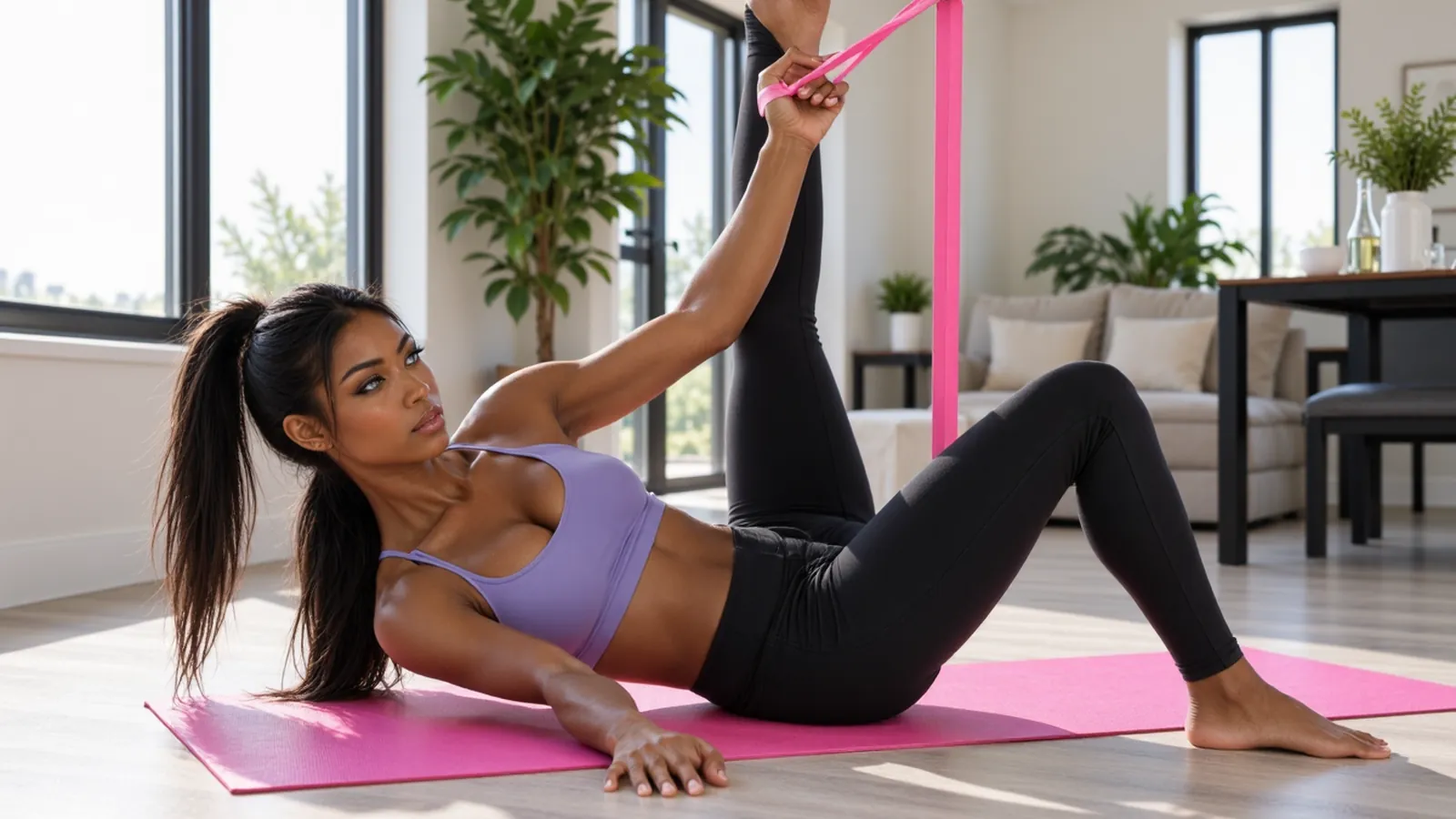
Fabric, latex, loops and flat bands: how they differ, what resistance a beginner should get and what to do with a band at home.
Contents
Types of bandsWhat resistance to get6 exercises with a mini loopHow to progress with bandsWhat to check when buyingA band is one of the cheapest ways to add load at home once bodyweight exercises get easy. It fits in a pocket and suits a small flat.
Does it really work? A meta-analysis by Lopes and colleagues (2019) pooled 8 studies comparing training with elastic resistance and with conventional weights (machines, dumbbells). Strength gains in the legs and arms were comparable across different groups of participants and different programs. There aren't many studies, so the conclusion is still preliminary.
Types of bands
| Type | What it looks like | Best for |
|---|---|---|
| Fabric mini loop | a wide fabric ring with rubber inside, about 30-40 cm long | glutes and thighs: bridges, abductions, squats |
| Latex mini loop | a thin rubber ring of the same length | the same, but it can roll up and pull at skin hair |
| Long loop | a big ring, 1-2 m | rows, presses, assisted pull-ups |
| Flat band without a loop | a flat strip of latex | rehab, gentle load, stretching |
| Tube with handles | a tube with two handles | exercises for arms, chest and back |
For leg and glute workouts at home, start with a fabric mini loop. For the upper body, a long loop or a tube with handles is useful.
What resistance to get
Brands mark resistance with colours or letters, but there's no single standard: one brand's "medium" can be stiffer than another's "heavy". Go by feel:
- Light. You can do 20-25 glute bridges and your muscles are only starting to tire.
- Medium. 12-15 reps take effort, the last 2-3 are hard.
- Heavy. 8-10 reps at your limit.
A beginner is best off with a set of 2-3 loops. Use the light one for abductions and warm-ups, the medium one for bridges and squats.
Put the mini loop just above your knees. That way it presses on the thigh muscles and doesn't slide onto the joint.
6 exercises with a mini loop
Do 3 rounds: 12-15 reps of each exercise, 60 seconds of rest between rounds. The whole workout takes about 20 minutes including the warm-up.
- Banded glute bridge. Lie on your back, feet on the floor, band above your knees. Lift your hips while gently pushing your knees out against the band. Pause at the top for 1 second.
- Banded squat. Band above your knees, feet shoulder-width apart. As you squat, keep your knees in line with your toes and don't let the band pull them in. We cover squat technique in detail in the squat article.
- Half-squat side steps. Band above the knees or on the shins. Drop into a shallow squat and take 10 steps to the side, then back. Don't bring your feet fully together.
- Quadruped kickback. Band above your knees. Without arching your lower back, push your bent leg back and up until your thigh is parallel to the floor. Reps on each leg.
- Clamshell. Lie on your side, knees bent, feet together, band above your knees. Lift the top knee without separating your feet. Don't let your hips roll back.
- Standing side leg raise. Hold a wall, band on your shins. Move your straight leg out to the side by 20-30 centimetres, torso upright.
Check the band before each workout: tears, cracks and worn spots mean it's time to replace it. A snapping latex band can hurt. Never point a stretched band towards your face.
How to progress with bands
When 15 reps with a band get easy, you have three options:
- Take a stiffer band.
- Stack two bands or move the band lower, onto your shins: a longer lever means a higher load.
- Slow the movement down and add a pause at the hardest point.
Bands combine well with bodyweight exercises. For example, you can swap the regular bridge and squat in the 20-minute circuit workout for banded versions.
What to check when buying
- A fabric loop width of 5-8 cm: narrow ones roll up more often.
- A rubberised strip inside the fabric so the loop doesn't slip on leggings.
- Neat seams with no loose threads.
- If you're allergic to latex, choose fabric or latex-free (TPE) bands and check the material on the packaging.
This article is general in nature and is not medical advice. If you have a chronic condition, an injury, are pregnant or feel pain during exercise, discuss the load with a doctor first. Learn more
Sources
- Lopes J.S.S. et al. Elastic resistance vs conventional resistance training: systematic review and meta-analysis (SAGE Open Medicine, 2019) — 8 studies: strength gains with bands comparable to machines and dumbbells
- Physical activity: recommendations for adults — WHO: muscle-strengthening activity on 2+ days a week
Read also
20-minute no-equipment home workout: a full-body circuit
Six exercises, a mat and a timer. The circuit suits beginners, takes 20 minutes including the warm-up and works your legs, glutes, back, chest and core.
Squats without mistakes: knees, back and depth
Where to put your feet, where your knees should point, whether they can go past your toes and how deep to sit. A step-by-step guide to the bodyweight squat.

How much protein you need a day if you work out at home
We work out your protein target per kilogram of body weight, split it across meals and build a day from ordinary food, no protein shakes required.