Squats without mistakes: knees, back and depth
Where to put your feet, where your knees should point, whether they can go past your toes and how deep to sit. A step-by-step guide to the bodyweight squat.
Contents
Starting positionGoing down and upCan your knees go past your toes?How deep to squatFive common mistakesHow to check your techniqueHow much to doA squat looks simple until you watch yourself from the side. Knees cave in, heels lift, the back rounds at the bottom. These mistakes move the load from your glutes and thighs onto your knees and lower back, and make balance harder. Below is a breakdown of the bodyweight squat: it is where both home workouts and dumbbell training begin.
Starting position
- Place your feet shoulder-width apart or slightly wider.
- Turn your toes out about 15-30 degrees. The exact angle depends on the shape of your hip joints: find the position where sitting at the bottom feels comfortable.
- Spread your weight across the whole foot: heel, base of the big toe and base of the little toe.
- Breathe in and lightly brace your stomach, as if getting ready for a light push to the belly.
- Reach your arms forward or fold them in front of your chest. It makes balance easier.
Going down and up
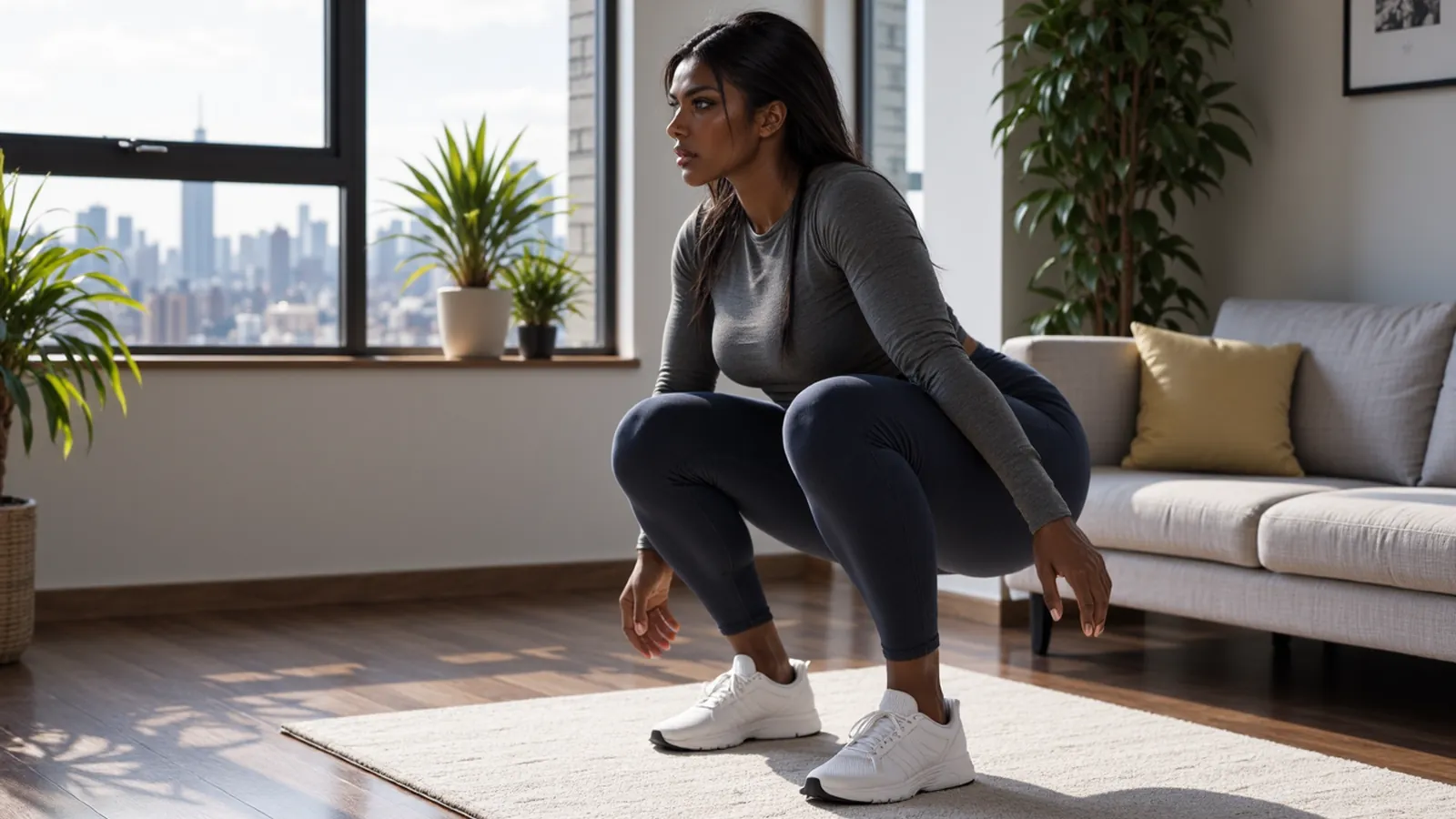
Start the movement at the hips and knees at the same time: hips go back and down, knees bend. Imagine sitting down on a low chair behind you.
Your knees point the same way as your toes the whole time. If they cave in, think about "spreading the floor" apart with your feet.
Pause briefly at the bottom, then stand up by pushing the floor away with your whole foot. Breathe out on the way up. At the top straighten up fully, but don't lean back.
Can your knees go past your toes?
Yes. The advice "knees must never pass your toes" sounds logical, but most people don't need it. In a deep squat the knees naturally travel a little forward, especially in people with long thighs.
In a study by Fry and colleagues (2003), seven trained men squatted with a barbell in two ways: normally and with a barrier that stopped the knees from passing the toes. With the barrier, the load on the knee dropped by about a fifth, but the load on the hip rose many times over and the torso leaned further forward. The authors suggest that this restriction shifts load to the hips and lower back, and conclude that the knees may need to move slightly past the toes for a healthy load distribution. The study is small and used a barbell squat, so its numbers don't carry over directly to a home squat. The principle is the same, though.
It matters more that your heels stay on the floor and your knees follow the line of your feet without caving in.
If you have a knee injury or knee pain when squatting, choose the range and the exercise variation together with a doctor or physiotherapist. General technique rules don't replace a look at your own case.
How deep to squat
Your working depth is the one where your back stays straight and your heels stay down. For many people that means thighs parallel to the floor or slightly lower.
Test it: squat down slowly and find the point where your lower back starts to round and your pelvis tucks under. Stop just above that point. Over time, as you work on hip and ankle mobility, depth usually improves.
Five common mistakes
| Mistake | Why it's a problem | How to fix it |
|---|---|---|
| Knees cave in | the load leaves the glutes, the knee works at an awkward angle | "spread the floor" with your feet; you can add a band above the knees |
| Heels lift | weight shifts to the toes, balance is lost | wider stance, toes turned out a bit more, less depth |
| Rounded back at the bottom | the lower back loses its neutral position | reduce depth, brace your stomach on the inhale |
| Strong forward lean | load shifts to the lower back | arms forward, chest facing forward, sit "between your heels" |
| Jerking up while holding your breath | harder to control the movement | slow on the way down, smooth on the way up, breathe out as you rise |
How to check your technique
Put your phone at waist height to the side, record 5 squats, then move the phone in front of you and record 5 more. From the side you see your back and heels, from the front your knees. Compare with the table above.
If the bodyweight squat isn't clean yet, use support:
- Box squat to a chair. Sit down until you touch the seat and stand straight back up. The chair sets the depth and catches you.
- Squat holding a door handle or a table. Hold on and lean back. It makes it easier to feel your hips moving back.
How much to do
For a beginner, 3 sets of 10-15 reps 2-3 times a week is enough. The squat is part of the 20-minute no-equipment workout, where it sits in a circuit with push-ups, bridges and a plank.
When 20 clean reps in a row feel easy, make it harder: lower slowly over 3-4 seconds, pause at the bottom, add a band above the knees or hold a dumbbell at your chest.
This article is general in nature and is not medical advice. If you have a chronic condition, an injury, are pregnant or feel pain during exercise, discuss the load with a doctor first. Learn more
Sources
- Fry A.C. et al. Effect of knee position on hip and knee torques during the barbell squat (J Strength Cond Res, 2003) — when knees are not allowed past the toes, load shifts to the hip; the authors suggest the lower back is overloaded
- Physical activity: recommendations for adults — WHO: muscle-strengthening activity on 2+ days a week
Read also
20-minute no-equipment home workout: a full-body circuit
Six exercises, a mat and a timer. The circuit suits beginners, takes 20 minutes including the warm-up and works your legs, glutes, back, chest and core.

How much protein you need a day if you work out at home
We work out your protein target per kilogram of body weight, split it across meals and build a day from ordinary food, no protein shakes required.
Resistance bands: which to choose and 6 exercises for glutes and legs
Fabric, latex, loops and flat bands: how they differ, what resistance a beginner should get and what to do with a band at home.